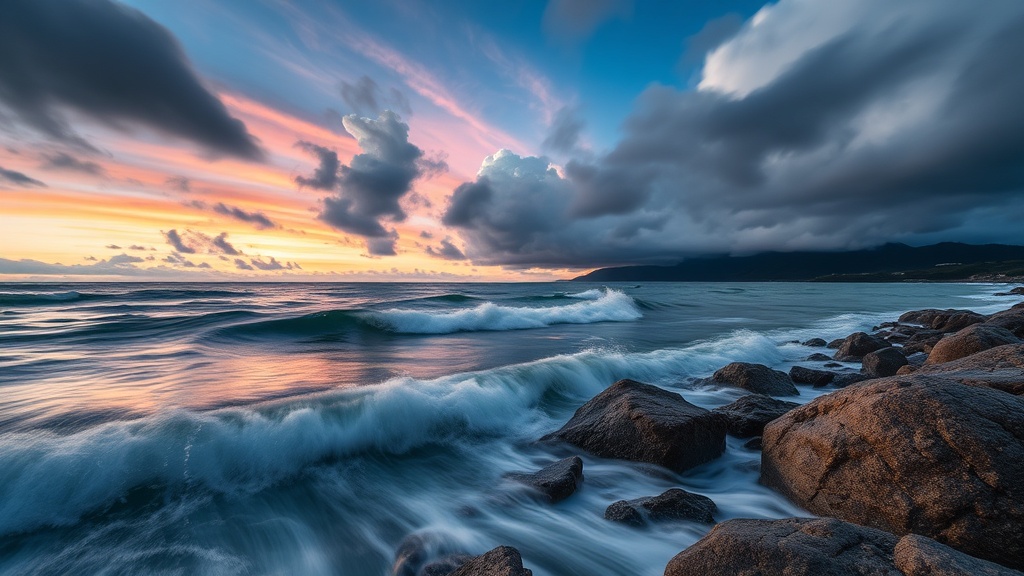
Long Exposure Techniques for Moving Water and Clouds

Understanding the Mechanics of Long Exposure
In this post, you'll learn how to use slow shutter speeds to transform moving elements—like rushing rivers or drifting clouds—into smooth, ethereal textures. We will cover the physical requirements for long exposure, the gear needed to keep your camera steady, and how to manage light when your shutter stays open for several seconds.
Long exposure photography isn't just about making water look like silk; it's a way to capture the passage of time within a single frame. When you leave your shutter open, the camera records movement as a blur. If you're shooting a waterfall, that movement becomes a soft, white veil. If you're shooting clouds, they turn into streaks of light. It's a beautiful effect, but it's also incredibly easy to mess up if you don't respect the physics of light and motion.
The first thing you need to understand is the relationship between shutter speed and light. A longer shutter speed means more light enters the sensor. If you try to shoot a 30-second exposure in the middle of a sunny afternoon without any light-controlling tools, your image will be a pure white, overexposed mess. You have to control the light to keep the details in the highlights.
What Gear Do I Need for Long Exposure?
You can't just hold your camera in your hands and hope for the best. Even the slightest tremor from your heartbeat or a light breeze will cause motion blur that looks like a mistake rather than an intentional effect. You need a tripod—and I mean a sturdy one. If you're shooting in a windy area near a coast, a cheap, lightweight tripod will catch the wind like a sail and ruin your shot.
Aside from a tripod, the most important tool in your bag is a Neutral Density (ND) filter. Think of an ND filter as sunglasses for your lens. It reduces the amount of light hitting the sensor without changing the color of the scene. This allows you to use much longer shutter speeds even during the day. Without an ND filter, your options for long exposure are mostly limited to twilight or nighttime.
- ND Filters: key for daylight shooting.
- Remote Shutter Release: Prevents camera shake when you press the button.
- Sturdy Tripod: Keeps the camera perfectly still.
- Extra Batteries: Long exposures can drain power faster.
A pro tip: even when using a remote shutter release, the act of pressing the button can shake the camera. I often use the 2-second timer setting on my camera to ensure the vibrations from my finger have settled before the shutter actually opens. It's a small step that makes a massive difference in sharpness.
How Do I Calculate Shutter Speed for Water?
There isn't one single "magic number" for water, because it depends entirely on the speed of the water and the amount of light. However, there are general rules of thumb. If you want to see individual splashes and droplets, keep your shutter speed fast (1/100s or faster). If you want that milky, smooth look, you'll likely need speeds of 1 second, 5 seconds, or even 30 seconds.
To find your setting, start with your ISO at the lowest possible value (usually 100) to minimize noise and maximize dynamic range. Then, adjust your aperture to a higher f-number like f/11 or f/16 to reduce light and increase depth of field. Finally, adjust your shutter speed until the water looks exactly how you want it. If you find your images are coming out too bright, you need a denser ND filter. For more technical details on how light behaves, you can check out the resources at Britannica's Optics section.
When shooting clouds, the shutter speed needs to be much longer to show visible movement. A 1-second exposure might not show much change in a cloud's position, but a 30-second exposure will create those long, streaky lines that look like they're racing across the sky. This is where the ND filter becomes your best friend, as it allows you to keep that shutter open even when the sun is up.
Can I Use Long Exposure for Daytime Landscapes?
Yes, you absolutely can, but you must use an ND filter. Without it, you'll be forced to use very high shutter speeds to avoid overexposure, which defeats the purpose. A common mistake is trying to use an ND filter that is too weak. If you want to hit a 30-second shutter speed in bright light, you'll likely need a 6-stop or 10-stop ND filter. This is a bit of a learning curve, but once you find the right balance, the results are stunning.
One thing to watch out for is the "color cast" that some cheaper ND filters can introduce. Sometimes, an ND filter can make your image look slightly blue or magenta. I always check my histogram to ensure I'm not losing detail in the shadows or blowing out the highlights. If you're interested in the physics of light and how it interacts with glass, PhET Interactive Simulations offers great tools to visualize light waves.
When you're out in the field, don't forget to check your focus before you start the long exposure. Autofocus can sometimes struggle when it's looking at a blur of moving water. I prefer to use manual focus once I've found my subject. Set your focus on a stationary rock near the water, then switch to manual so the camera doesn't try to "hunt" for focus while the shutter is open.